
Commercial
Commercial Flat Roof Maintenance Plans for Boca Raton and Broward Businesses
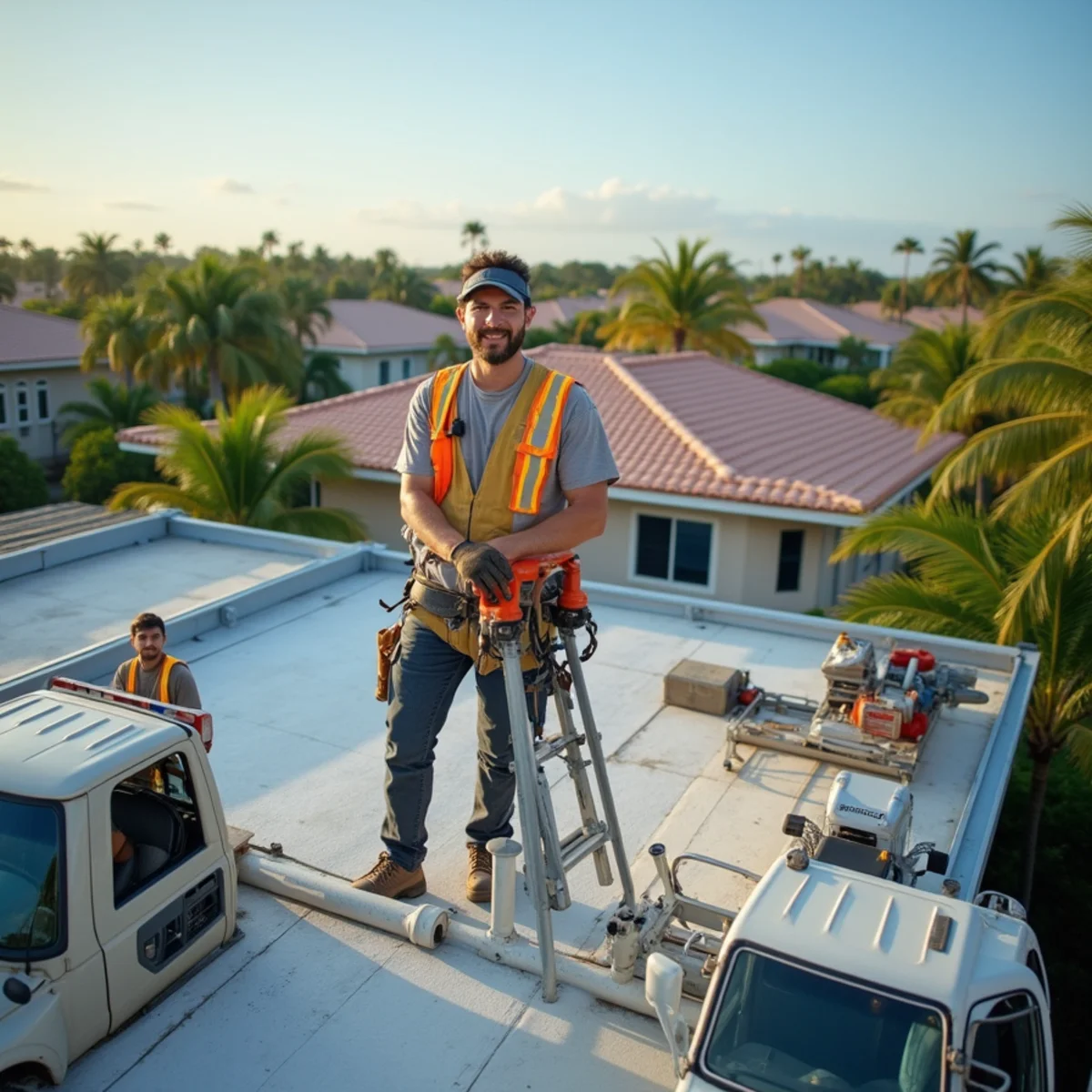
A leaking commercial roof rarely fails without warning signs. A structured maintenance plan catches those signs during a scheduled visit instead of during a business-interruption emergency.
Most commercial flat roof failures do not happen without warning. A membrane seam that's slowly opening, a drain that's partially clogged, ponding water that's been sitting longer than it should, these are all visible during a scheduled inspection long before they become an active leak over inventory, equipment, or a tenant's ceiling. The businesses that avoid emergency roof calls are almost always the ones running a structured maintenance plan instead of waiting for a problem to announce itself.
What a real commercial maintenance plan includes
- Scheduled inspections, typically twice a year, in spring before hurricane season and again in fall, plus after any major storm event.
- Drain and scupper cleaning to prevent the ponding water that shortens the life of TPO, modified bitumen, and coated roof systems.
- Seam and flashing checks at every penetration, HVAC curbs, pipe boots, parapet walls, since these transition points fail long before the field membrane does.
- Membrane condition assessment, looking for blistering, granule loss on modified bitumen, or coating wear on a fluid-applied system.
- Photo documentation after every visit, creating a maintenance record that satisfies most manufacturer warranty requirements.
- Priority response terms for active leaks, so a maintenance client isn't competing with new-project scheduling during an emergency.
Why manufacturer warranties often require documented maintenance
Many TPO and modified bitumen manufacturer warranties are conditional on documented, regular maintenance and specifically exclude damage attributable to neglect, ponding water beyond a certain duration, or unaddressed seam failures. A business that skips maintenance can find itself with a warranty on paper that a manufacturer declines to honor in practice, because there's no inspection record showing the roof was properly maintained. A structured plan through our commercial roofing team creates exactly that paper trail.
TPO, modified bitumen, and coatings: different maintenance needs
| System | Key maintenance focus |
|---|---|
| TPO (single-ply) | Seam integrity, punctures from foot traffic or rooftop equipment work, drain clearance |
| Modified bitumen | Granule wear, blistering, flashing detail at walls and penetrations |
| Fluid-applied coatings | Recoat cycle timing, ponding water tracking, coating thickness at high-wear areas |
Coated roofs in particular benefit from a planned recoat cycle rather than waiting until the coating has fully worn through, since recoating an intact substrate is far less expensive than replacing a membrane that failed from prolonged UV and water exposure after the coating gave out.
Protect your building and your warranty with a scheduled commercial flat roof maintenance plan. Call (831) 666-1600 for a facility walkthrough and proposal.
Business interruption is the real cost of reactive maintenance
The cost comparison businesses actually care about isn't maintenance-plan cost versus doing nothing, it's a scheduled inspection versus an emergency leak that closes a retail floor, damages inventory, or shuts down a server room over a weekend. Reactive repairs also tend to cost more per call than a planned visit, since emergency response often means after-hours labor and, at times, temporary weatherproofing before a permanent fix can be scheduled.
What a licensed roofer checks on a TPO membrane during a maintenance visit
A visual walkaround only catches so much. On TPO systems, we run a seam probe along heat-welded seams to check for early separation that has not yet opened enough to leak but is trending that way, and we check for membrane pull-away at parapet walls and curbs, a common aging pattern on TPO that is easy to miss from a distance. Fastener plates cupping or telegraphing through the membrane, visible as a faint pattern of raised dots across the field, is another detail we check, since it signals movement in the deck attachment below the membrane itself.
Ponding water gets measured, not just noted. If water is still standing on the membrane roughly 48 hours after rain stops, we flag it as a drainage issue that needs correcting, whether that means clearing a partially blocked drain, adding a scupper, or, on a low or reverse-sloped section, tapered insulation to redirect flow. Left alone, standing water accelerates UV breakdown of the membrane and adds weight load the roof deck was not designed to carry long-term.
Our flat roofing maintenance visits document all of this with dated photos tied to the specific location on the roof, both for the manufacturer warranty paper trail and so a facility manager can see whether a given seam or drain issue is new since the last visit or a recurring spot worth a permanent fix instead of another temporary patch.
Rooftop traffic from HVAC technicians and other trades is another thing we account for during a maintenance visit, not just weather and age-related wear. Repeated foot traffic to a rooftop unit without walk pads gradually wears a path into the membrane that is easy to overlook until it becomes a soft spot. We flag high-traffic paths to rooftop equipment and recommend walk pads at the routes technicians actually use, which is a small, inexpensive addition that meaningfully extends membrane life around equipment that gets serviced several times a year.
Serving businesses from Boca Raton into Broward County
We run maintenance plans for commercial properties from our Boca Raton base north through Palm Beach County and south into Broward, including Fort Lauderdale and Pompano Beach, where flat and low-slope commercial roofs are common on retail centers, office buildings, and light industrial properties. Buildings in Broward's HVHZ jurisdiction have additional product-approval considerations if a maintenance visit uncovers damage significant enough to require a section replacement rather than a repair, which we account for when scoping any commercial work south of the county line.
A maintenance plan does not prevent every roof problem, but it moves the vast majority of them into a scheduled, budgeted repair instead of an emergency call. For a property owner or facility manager, that predictability is usually worth more than the plan itself costs.
Frequently asked questions
Talk to a licensed Boca Raton roofer
Get a free drone inspection and a written estimate from Boca Raton's trusted, licensed roofing team. Same-day response, no pressure.