
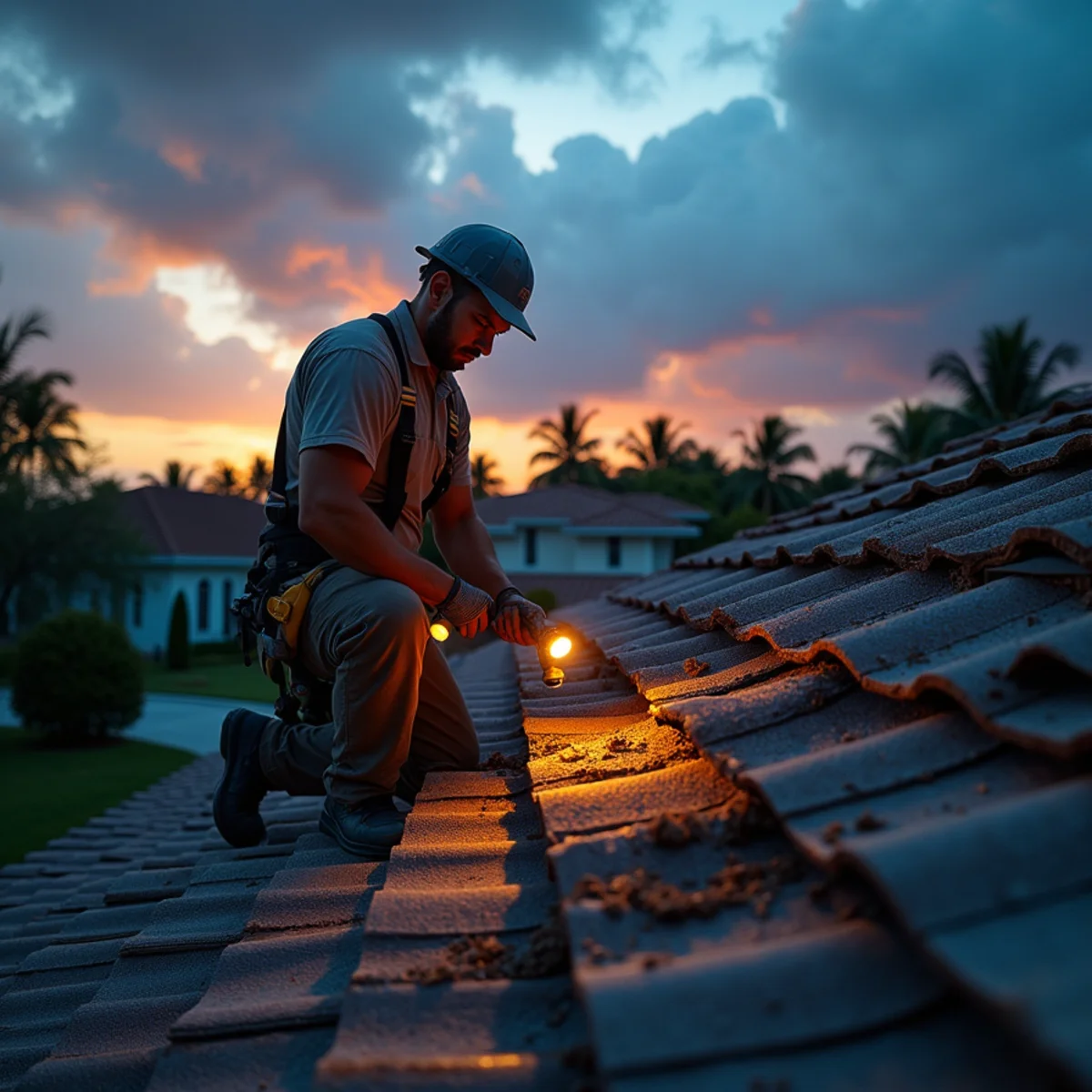
A roof emergency in Boca Raton rarely waits for business hours. Water pushing through the ceiling at 9 p.m., a section of tile that lifted in a squall line, or a tree limb through the deck all get worse by the hour. Call (831) 666-1600 and reach a real person who can dispatch a crew, not a voicemail box. We keep tarps, dry-in materials, and boards staged so we can get to homes across Palm Beach County quickly and stop the water from doing more damage inside.
While you wait for us, do what you safely can from the ground. Move furniture and electronics clear of the drip, pull up rugs, and put a bucket under the leak. If water is bulging a ceiling, poke a small relief hole over the bucket so the drywall does not collapse. Do not climb onto a wet roof, and stay away from any limb touching a power line. As a Florida state-certified, insured roofing contractor based on N Federal Highway, we handle the part that needs a ladder and a harness.
Signs you need emergency repair in Boca Raton
Active interior leak
Water staining a ceiling or running down a wall during rain means the roof envelope is open somewhere. Every hour it runs, it soaks insulation, framing, and drywall, and mold can start within 24 to 48 hours.
Blown-off or slipped tiles
A gust can lift barrel or flat tile and expose the underlayment, or strip the underlayment itself. Even if the ceiling is still dry, the next storm will find the opening.
Storm impact or puncture
Fallen limbs, flying debris, or a failed skylight can punch straight through the deck. These openings need boarding and a watertight cover the same day.
Peeled flat-roof membrane
High wind can catch the edge of a flat or low-slope membrane and roll it back like a lid, leaving the substrate fully exposed to the next downpour.
Our process
- 1
Call and rapid triage
When you call (831) 666-1600, we get your address, roof type, and where the water is showing, then give you a realistic arrival window and the safe steps to take inside in the meantime.
- 2
On-site assessment and photos
Our crew locates the actual opening, which is often several feet uphill from where water appears inside, and photographs everything before touching it so you have a documented record for your insurer.
- 3
Emergency dry-in
We stop the water first with a properly fastened tarp, shrink-wrap, or a temporary patch to the underlayment, depending on the roof. See our <a href="/roof-tarping/">roof tarping service</a> for how we secure larger openings.
- 4
Damage scope and permanent-repair plan
Once the roof is stable, we walk you through what failed and lay out the permanent fix, whether that is a targeted <a href="/roof-leak-repair/">leak repair</a> or a larger scope after a storm.
- 5
Documentation for your claim
We hand off the dated photo report and a written scope you can send to your carrier, and we can meet the adjuster on site. Our <a href="/roof-insurance-claims/">insurance claim support</a> explains that process.
Why the leak inside is not where the roof is open
Homeowners often point us to the wet spot on the ceiling and expect the roof breach to be directly above it. Water almost never behaves that way. It enters at a high point, then travels along the underside of the deck, down a truss, or across the top of a ceiling until it finds a seam or a light fixture to drip through. That is why a proper emergency repair starts with tracing the water back to its real entry point rather than slapping a patch over the interior stain.
On tile roofs the entry is frequently a cracked or slipped tile combined with failed underlayment at a valley or a headwall. On flat sections it is usually a seam, a pitch pan, or a lifted edge. Finding it fast is what separates a repair that holds from one that leaks again in the next storm, so our crews carry moisture meters and know the failure points common to South Florida roofs.
When an emergency repair should become a replacement
A temporary dry-in buys time; it is not the answer for a roof that has reached the end of its life. If we are patching the same roof for the third time in different spots, or if a storm has cracked tile across a whole slope and softened the decking underneath, the honest recommendation is often a full roof replacement rather than another repair. Florida's 25% rule also matters here: once repairs touch more than a quarter of a roof section in a year, that section generally has to be brought to current code.
We will tell you plainly which situation you are in. If a repair makes sense, we do the repair. If the numbers point to replacement, we show you the photos and the reasoning so you are not paying to nurse a roof that should be replaced.
Emergency Repair across Palm Beach & Broward County
We run emergency crews across two counties from our N Federal Highway base. In Palm Beach County we reach Delray Beach, Boynton Beach, and Highland Beach quickly, often the same day outside a widespread storm. South across the Hillsboro Canal we cover Deerfield Beach, Pompano Beach, and Coral Springs in Broward. The dry-in that stops the water is the same everywhere; getting to you fast is the priority.
The permanent repair is where county code diverges. Deerfield Beach, Pompano Beach, and the rest of Broward sit in the High-Velocity Hurricane Zone, so replacement materials there need a Miami-Dade NOA or HVHZ product approval and HVHZ fastening. Palm Beach County is not in the HVHZ and works under Florida Product Approval with the roughly 170 mph design wind speed. We match the temporary cover to the emergency and the permanent scope to whichever code governs your address.
What affects your price
Emergency work is priced on what it takes to make the roof safe and watertight right now, then a separate written scope covers the permanent repair. These are planning ranges; the on-site assessment sets the real number.
- Time of call
- After-hours and severe-weather calls carry a mobilization cost because we are staging crews and materials outside normal hours.
- Size of the opening
- A single slipped tile is a fast fix; a peeled membrane or a limb through the deck needs boarding, more material, and more labor.
- Roof type and pitch
- Steep tile and multi-level roofs need more staging and safety setup than a single-story flat roof.
- Access and conditions
- Working in active rain or wind, or on a roof with poor access, adds time and safety measures.
- Insurable event
- When damage comes from a covered storm, emergency mitigation is often reimbursable, and we document it so it can be submitted.
These are honest planning ranges, not a quote. Your written scope confirms the real price after a free inspection. Call (831) 666-1600.
Why choose Mighty Dog Roofing for emergency repair
- A real person answers 24/7 at (831) 666-1600, not an answering service
- Tarps, dry-in materials, and boards staged for fast dispatch across Palm Beach County
- Dated photo documentation of the damage before we touch it
- Florida state-certified, insured contractor, so the temporary fix is done to code
- Clear handoff from emergency dry-in to a written permanent-repair scope
- Daily jobsite cleanup with magnetic nail sweeps once the permanent work begins