
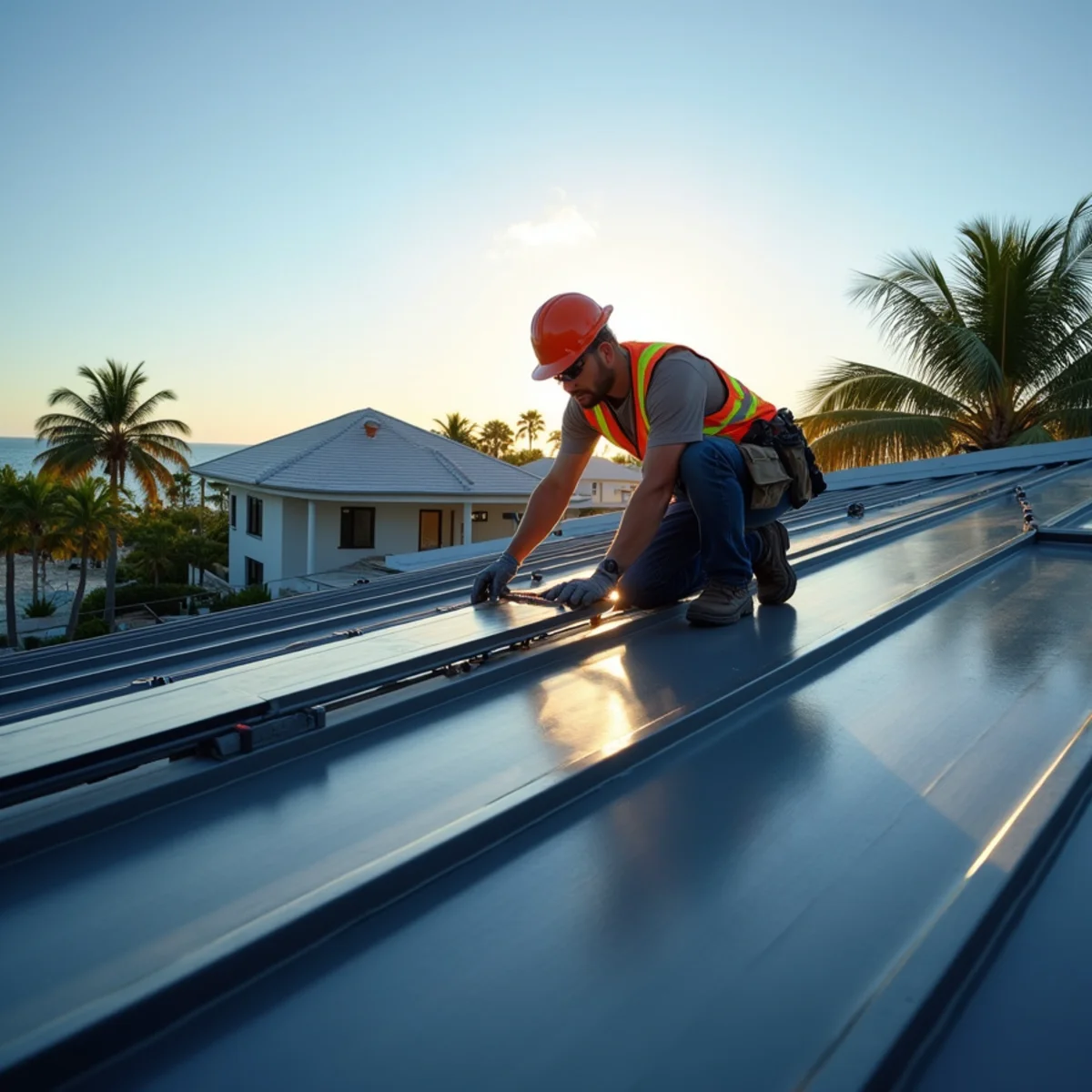
Metal has become the roof of choice for Boca Raton homeowners who want one roof that outlives the mortgage. A properly installed standing seam or 5V system carries 40-plus years of service, sheds our summer downpours instantly, and earns strong wind-mitigation credits. In a market where insurers keep tightening their rules, that combination of lifespan and premium savings is hard to beat.
As a Florida state-certified, insured contractor, we install concealed-fastener standing seam and traditional 5V crimp panels in aluminum and coated steel, all fastened to the 2023 Florida Building Code for our roughly 170 mph design-wind zone. Near the ocean and Intracoastal we specify aluminum and stainless hardware to resist salt corrosion, and every metal roof starts with a free drone inspection and a written scope.
Signs you need metal roofing in Boca Raton
End-of-life shingle or tile
Homeowners facing a third re-roof often switch to metal to stop the replacement cycle. One metal roof can outlast two or three shingle roofs.
Rising insurance costs
A code-fastened metal roof with documented wind-mitigation features can earn meaningful premium credits and helps satisfy carrier roof-age rules.
Exposed-fastener panel leaks
Cheap through-fastened metal relies on rubber washers that dry out and back out over time. We install concealed-fastener standing seam that avoids thousands of roof penetrations.
Salt-air corrosion on coastal homes
Steel panels and mismatched fasteners rust quickly east of Federal Highway. The fix is marine-appropriate aluminum panels and compatible stainless hardware.
Our process
- 1
Free drone inspection & panel selection
We fly the roof, review your slope and structure, and help you choose between standing seam and 5V and between aluminum and coated steel for your exposure.
- 2
Permits & product approval
We pull the re-roof permit and submit Florida Product Approval / NOA documentation for the panel, clips, and underlayment so the assembly is code-legal for our wind zone.
- 3
Tear-off, deck & high-temp underlayment
We strip to the deck, re-nail sheathing to code, and install a high-temperature self-adhered underlayment suited to the heat that builds under metal.
- 4
Panel fabrication & concealed-fastener install
Standing seam panels are cut to length and fastened with concealed clips that allow thermal movement, then seamed; 5V is fastened through approved patterns at the proper spacing.
- 5
Trim, final inspection & warranty
We finish ridge, hip, and edge trim, pass the municipal final, and hand you the paint and workmanship warranties plus the wind-mitigation report your insurer wants.
Standing seam vs. 5V crimp for Boca Raton homes
The two metal systems we install most look different and behave differently. Standing seam uses wide, flat panels joined by raised vertical seams with the fasteners hidden underneath, so nothing penetrates the water plane. It is the cleaner, higher-performance choice and the one we recommend for most re-roofs. Traditional 5V crimp is the classic Florida panel with exposed fasteners set in an engineered pattern; it costs less and suits many cottages, cabanas, and simpler roofs, but it depends on gasketed fasteners that need eventual attention.
On low-slope sections a metal panel is not appropriate at all, and we will steer you to a flat or low-slope system for those areas. If you are still comparing materials, our tile vs. metal guide weighs wind, salt air, and lifespan side by side.
Metal, salt air, and hurricane season
Metal's biggest advantages in South Florida are wind resistance and longevity, but both depend on getting the details right. A concealed-fastener standing seam roof fastened to the current code performs extremely well against uplift, which is why it pairs so naturally with a wind-mitigation upgrade and the premium credits that come with it. Near the water, though, the wrong metal corrodes fast, so we specify aluminum panels and compatible stainless or aluminum trim and fasteners for homes covered on our coastal and salt-air roofing page.
Done correctly, a metal roof is one of the strongest storm defenses you can put on a Boca home, and the wind-mitigation report we provide gives your insurer the documentation to credit it.
Finishes, color, and the low maintenance metal actually needs
Modern metal roofs are finished with factory-applied paint systems that hold color and resist chalking in our sun for decades, and they come in profiles and shades that read as intentional on everything from a coastal contemporary to a barrel-tile neighborhood. Reflective finishes also cut the heat that reaches your attic, which matters on a South Florida cooling bill. We help you match the panel and color to your home and any HOA palette, and we handle the color submittals an association or architectural review board requires before we order material.
Metal is low maintenance, not no maintenance. A standing seam roof mostly needs an annual rinse of salt and debris, a look at the sealant and boots at penetrations, and attention to any trim that works loose over years of thermal movement. On a 5V panel we keep an eye on the gasketed fasteners that can back out with age. A short yearly check under our free maintenance visit catches these small items long before they become a leak, and keeps the paint and workmanship warranties intact.
Metal Roofing across Palm Beach & Broward County
Our metal roofs go up across Palm Beach and Broward County, including salt-exposed homes in Highland Beach, Lighthouse Point, and Pompano Beach, plus inland roofs in Coral Springs and Coconut Creek. In Palm Beach County, outside the HVHZ, standing seam and 5V panels are permitted with Florida Product Approval for the panel, clips, and underlayment.
South of the Hillsboro Canal in Broward, the same panels have to carry a Miami-Dade NOA and pass TAS uplift testing to be legal in the High-Velocity Hurricane Zone. Concealed-fastener standing seam resists uplift well in either county, but the approval path is stricter in Broward, so we specify NOA-listed clip patterns and fastener spacing for homes in Parkland and Deerfield Beach.
What affects your price
Metal costs more up front than shingle but far less over its life. We price from a written scope, and these planning ranges help you weigh it against other systems.
- Panel type
- Installed metal roofs commonly run $8–$20 per square foot, or roughly $18,000–$50,000+ on a 2,000–2,400 sq ft roof, with standing seam above 5V.
- Aluminum vs. steel
- Aluminum resists salt corrosion and is preferred near the coast; coated steel can cost less inland where salt exposure is lower.
- Roof geometry
- Hips, valleys, dormers, and curved sections add fabrication, trim, and labor compared with a simple gable.
- Underlayment
- A high-temperature self-adhered underlayment is used under metal because of the heat that builds beneath the panels.
- Insurance offset
- Wind-mitigation credits and longer lifespan reduce the real long-term cost, which we help you document for your carrier.
These are honest planning ranges, not a quote. Your written scope confirms the real price after a free inspection. Call (831) 666-1600.
Why choose Mighty Dog Roofing for metal roofing
- Concealed-fastener standing seam that avoids thousands of roof penetrations
- Aluminum panels and stainless hardware specified for coastal and Intracoastal homes
- Code-rated fastening for our roughly 170 mph design-wind zone
- High-temperature underlayment matched to the heat under metal
- Wind-mitigation documentation prepared for your insurer
- Free drone inspection and a written, line-item scope before you commit