
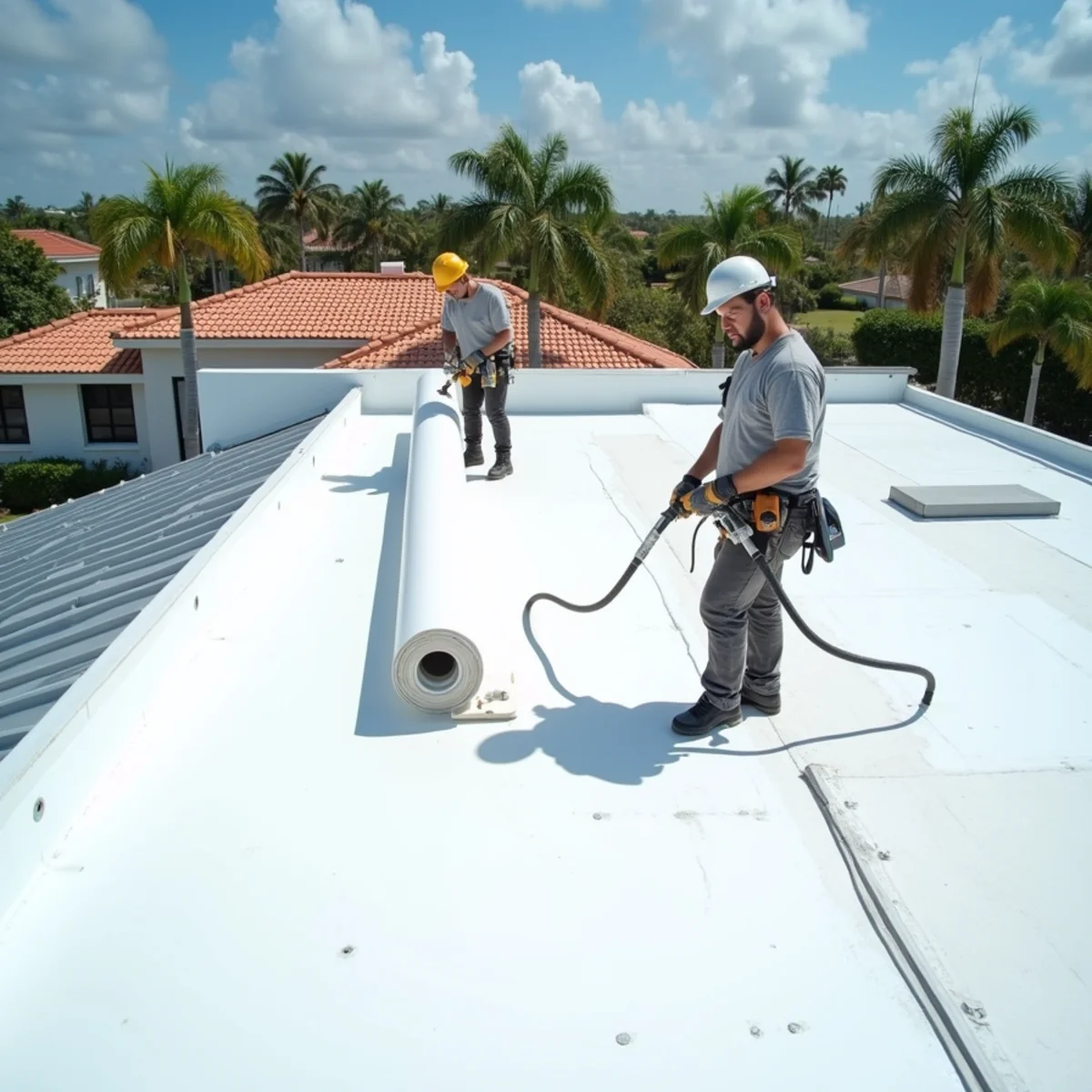
Flat and low-slope roofs are everywhere in Boca Raton: mid-century additions, screened-porch conversions, condo buildings, and the entire back half of many split-level homes. They fail differently than sloped roofs. Water does not run off a flat roof, it sits, so the membrane, the seams, and the drainage have to be right or the roof ponds and leaks. Getting a low-slope system to last here is about detail work, not just rolling out material.
As a Florida state-certified, insured contractor, we install and replace modified bitumen, TPO single-ply, and fluid-applied coating systems on residential, condo, and light commercial roofs. We diagnose why a flat roof is holding water, correct the slope and drainage where we can, and build the membrane and flashing to shed our summer storms. Every low-slope project starts with a free drone and moisture assessment and a written scope.
Signs you need flat roofing in Boca Raton
Ponding water
Standing water that lingers more than a day or two after rain accelerates membrane breakdown and is a leading cause of low-slope failure in South Florida.
Open or split seams
Seams are the weak point of any flat roof. Heat cycling and age split laps and let water track far from where it finally drips inside.
Failed flashing at walls and curbs
Where a low-slope roof meets a wall, parapet, skylight, or HVAC curb, old flashing pulls away and becomes the entry point for leaks.
Blistered or alligatored coatings
Old modified bitumen and coatings blister, crack, and alligator under UV, losing their waterproofing long before the roof looks obviously bad from the ground.
Our process
- 1
Free drone & moisture assessment
We inspect the field, seams, flashings, and drains, document ponding areas, and identify whether trapped moisture means a recover or a full tear-off is appropriate.
- 2
System selection & written scope
We recommend modified bitumen, TPO, or a coating based on your roof's use, slope, and condition, and give you a line-item scope with the drainage corrections spelled out.
- 3
Permits & product approval
We pull the permit and submit Florida Product Approval / NOA documentation for the membrane and insulation so the assembly meets code for your building.
- 4
Tear-off or prep, and drainage correction
We remove failed material or prep the existing surface, address ponding with tapered insulation or added drains where feasible, and repair the deck as needed.
- 5
Membrane, flashing & final inspection
We install the membrane with fully sealed seams and new flashing at every wall, curb, and drain, then pass the municipal final and hand you the warranty documentation.
Modified bitumen, TPO, or a coating?
There is no single best flat roof for every building, so we match the system to the roof. Modified bitumen is a proven, multi-ply membrane that handles foot traffic and residential additions well. TPO is a reflective single-ply that keeps the roof and the rooms below it cooler, which makes it popular on condo and commercial decks. Fluid-applied coatings can extend the life of a sound existing roof at a lower cost, but only when the substrate underneath is dry and stable. The wrong call is coating a roof that has trapped moisture, which just seals the water in.
Our guide to South Florida flat-roof options compares these systems in detail, and larger buildings should also see our commercial roofing page.
Why ponding is the real enemy on a low-slope roof
A flat roof is never truly flat; it is built with a slight slope so water finds a drain. When that slope is lost through settling, added weight, or a bad original install, water ponds and sits in the sun, and standing water is the single biggest reason low-slope roofs fail early here. Simply installing a new membrane over a ponding roof repeats the problem. Where the structure allows, we correct drainage with tapered insulation or additional drains so the water actually leaves the roof.
If a flat section is actively leaking, that is a roof leak repair we can address quickly, but a roof that ponds after every storm is usually telling you it needs a real drainage correction rather than another patch.
Flat Roofing across Palm Beach & Broward County
We install low-slope and flat systems for homes, condos, and commercial buildings across Palm Beach and Broward County, from the mid-century additions of Delray Beach and Boynton Beach to condo decks in Pompano Beach and Fort Lauderdale. In Palm Beach County, outside the HVHZ, TPO, modified bitumen, and coating assemblies are permitted with Florida Product Approval for the membrane and insulation.
In Broward cities such as Coral Springs, Tamarac, and Deerfield Beach, the same roofs sit inside the High-Velocity Hurricane Zone and need Miami-Dade NOA-approved membrane assemblies with TAS-tested attachment. The ponding and drainage work is identical across the county line, but the wind-uplift approval for a single-ply system is stricter in Broward, and we scope each roof to the code that governs it. On occupied condo and commercial buildings in Fort Lauderdale and Pompano Beach, we also phase the work around tenants and rooftop equipment so the building keeps running while the membrane goes down.
What affects your price
Flat-roof pricing depends heavily on the system, the amount of tear-off, and how much drainage correction the roof needs, so we price from a written scope after we see it.
- System type
- TPO and other flat systems commonly run $9–$14 per square foot installed; modified bitumen and coatings vary with layers and prep.
- Tear-off vs. recover
- A roof with trapped moisture needs a tear-off; a sound substrate may allow a recover or coating, which costs less.
- Drainage & ponding fixes
- Tapered insulation or added drains to break up ponding add material and labor but are often what makes the new roof last.
- Flashing details
- Parapet walls, HVAC curbs, skylights, and drains each require custom flashing that drives the labor on a flat roof.
- Roof size & access
- Larger condo and commercial decks and difficult rooftop access affect staging and crew time.
These are honest planning ranges, not a quote. Your written scope confirms the real price after a free inspection. Call (831) 666-1600.
Why choose Mighty Dog Roofing for flat roofing
- We diagnose and correct ponding, not just cover it over
- Modified bitumen, TPO, and coating options matched to how the roof is used
- Moisture assessment to decide honestly between recover and tear-off
- Custom flashing at every wall, curb, skylight, and drain
- Fully sealed seams installed to manufacturer specification
- Free drone inspection and a written, line-item scope before you commit